
Navy Body Fat Calculator — US Navy Method for Men and Women
This free navy body fat calculator estimates your body fat percentage using the US Navy method, the circumference-based formula the military has used to assess body composition since 1984. Enter a handful of tape-measure readings — neck, waist, height, and hips for women — and you get your body fat percentage, your category, and your fat and lean mass in seconds. No scale, no calipers, no appointment. The category ranges on this page follow the body-composition norms published by the American Council on Exercise, and the method itself traces to research by the Naval Health Research Center.
Body fat percentage tells you something your bathroom scale and your BMI cannot: how much of your weight is fat versus muscle, bone and water. That is why the US Navy body fat calculator is a better progress signal than weight alone — you can lose fat, gain muscle, and see no movement on the scale while this number drops. It is an estimate, not a lab test, and we are honest below about where it is accurate and where it is not.
Calculate Your Body Fat Percentage Now (Metric & Imperial Calculator)
Navy Body Fat Calculator
Estimate your body fat percentage with the US Navy circumference method. Enter a few tape-measure readings – no scale needed.
0.0%
- Healthy / fitness range for your sex–
- Fat mass–
- Lean (fat-free) mass–
- MethodUS Navy circumference
Disclaimer : This Body Fat calculator is for informational and educational purposes only and should not be used for medical diagnosis or as a substitute for professional healthcare advice.
What This Navy Body Fat Calculator Gives You
Enter your measurements once and the tool returns a full body-composition picture, not just a single number:
- Your body fat percentage, to one decimal place, from the official US Navy circumference formula.
- Your category against standard norms: essential fat, athletic, fitness, average/acceptable, or above average — read on the correct scale for your sex.
- The fitness range for your sex, so you have a target rather than an abstract figure.
- Your fat mass and lean (fat-free) mass, if you add your weight — the split the scale can never show you.
- A position marker on a colour-coded body-fat scale, so you can see where you sit at a glance.
- A context note that flags very low readings, higher readings, and how the result relates to the US Navy's own standards.
You can work in metric (centimetres and kilograms) or imperial (inches and pounds), and switch between male and female formulas. Age and weight are optional — they add context and the mass breakdown without changing the core percentage.
How to Measure for the Navy Method
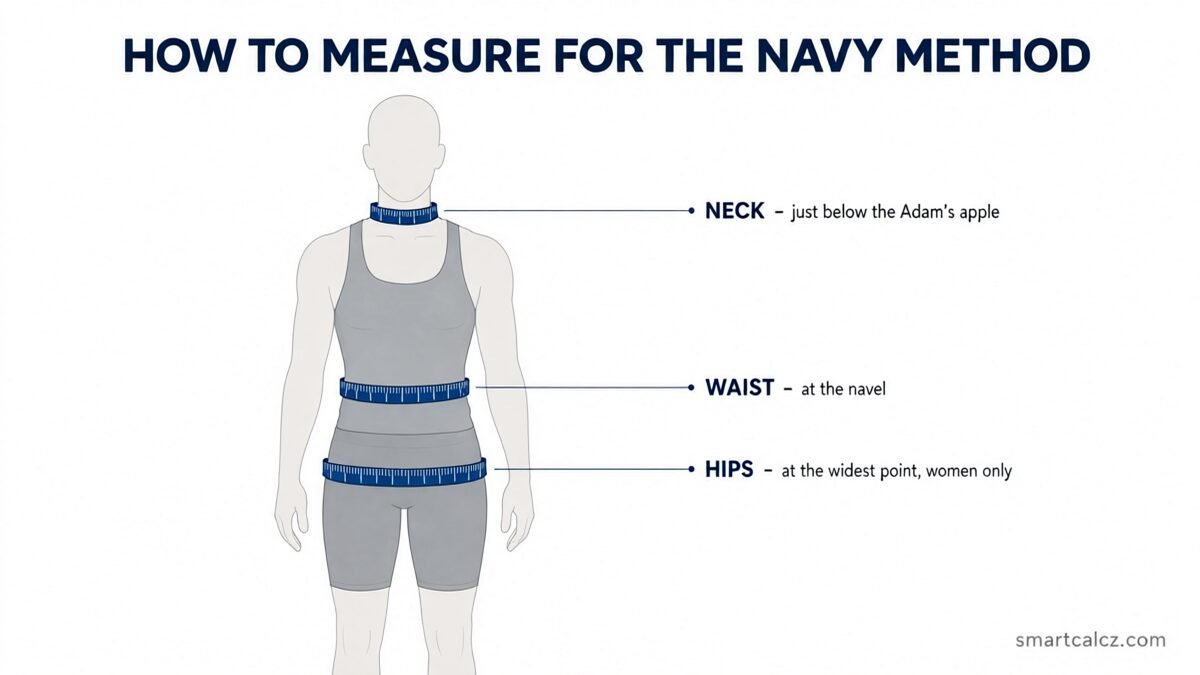
A flexible cloth or vinyl tape measure is all you need. Measure against bare skin, keep the tape snug but not compressing, parallel to the floor, and breathe normally — do not suck in. For the best consistency, measure first thing in the morning before eating or drinking.
- Neck: just below the larynx (Adam's apple), with the tape sloping slightly downward to the front. Keep your head up and shoulders relaxed.
- Waist: men measure at the navel; the Navy itself uses the abdomen at the level of the belly button. Measure at the end of a normal breath out.
- Hips (women only): around the widest part of the hips and buttocks.
- Height: stand straight against a wall without shoes.
Round to the nearest half-centimetre or quarter-inch, and if a reading looks off, take it twice and average. Because the formula is sensitive to the waist-minus-neck difference, a sloppy waist measurement is the single biggest source of error — take your time with that one.
The US Navy Body Fat Formula (Men and Women)
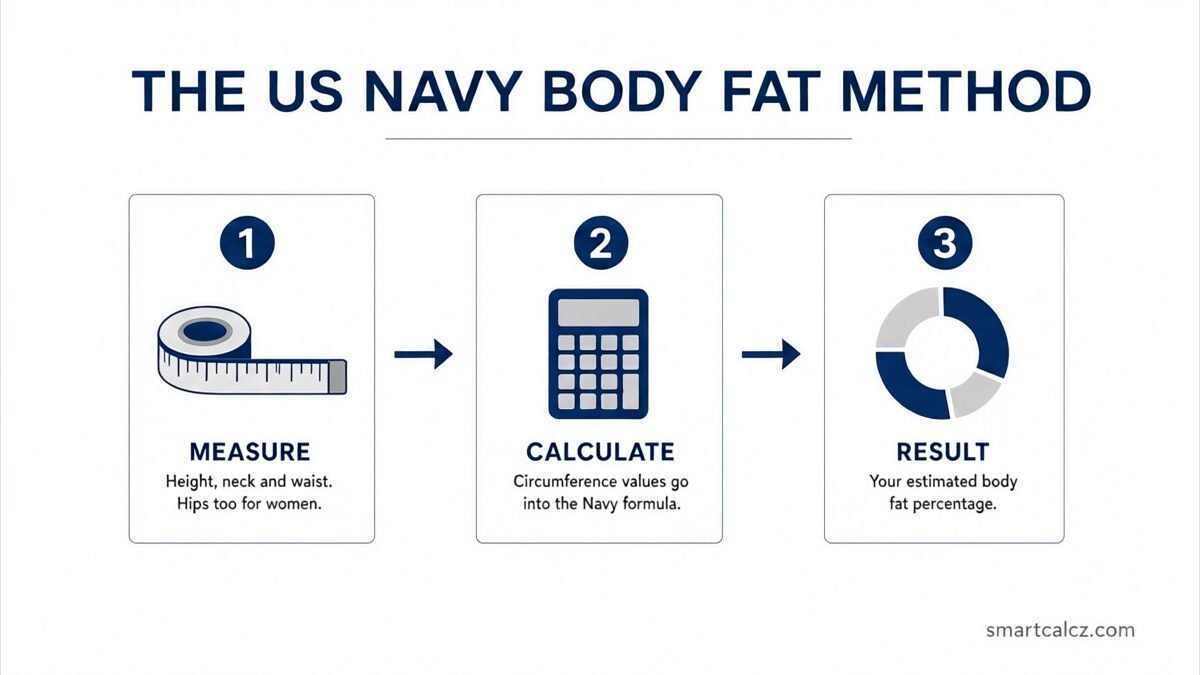
The Navy method does not weigh you. Instead it estimates body density from body circumferences and converts that to a fat percentage. The equations were developed by Hodgdon and Beckett at the Naval Health Research Center in 1984 and are still the basis of the Department of Defense circumference method today. Both sexes use a logarithmic formula; women add the hip measurement because female fat distribution differs.
Navy body fat formula for men
Imperial (inches): %BF = 86.010 × log10(waist − neck) − 70.041 × log10(height) + 36.76
Metric (centimetres): %BF = 495 ÷ [1.0324 − 0.19077 × log10(waist − neck) + 0.15456 × log10(height)] − 450
Navy body fat formula for women
Imperial (inches): %BF = 163.205 × log10(waist + hip − neck) − 97.684 × log10(height) − 78.387
Metric (centimetres): %BF = 495 ÷ [1.29579 − 0.35004 × log10(waist + hip − neck) + 0.22100 × log10(height)] − 450
Both the imperial and metric forms give essentially the same answer; the calculator above converts everything to centimetres internally and uses the metric equation, which is the form the official DoD calculators use. The formulas are documented in the Naval Health Research Center studies and reproduced in anthropometry teaching references such as LibreTexts Medicine.
Navy Body Fat Calculator Accuracy: How Reliable Is It?
The US Navy method is typically accurate to within about 3–4% of a laboratory body-fat measurement when you measure carefully. That makes it one of the better no-equipment estimates available — good enough to track real change over weeks and months, not precise enough to treat a single decimal point as gospel.
Here is how it compares with other ways to measure body fat:
- DEXA scan and hydrostatic weighing are the reference standards, accurate to roughly 1–2%, but cost $50–$200 per session and need a clinic. Impractical for regular tracking.
- Skinfold calipers can be very accurate in trained hands, but results swing widely with technique and are hard to reproduce yourself.
- Bioelectrical impedance scales and handheld devices are convenient but drift with hydration, food, and even room temperature, often by several percentage points day to day.
- The Navy circumference method sits in the sweet spot: free, repeatable, and dependent only on a tape measure and consistent technique.
Its known blind spot is body shape. Because it infers fat from where the Navy assumes fat accumulates, it can over-estimate body fat in people who carry a lot of abdominal muscle, and under-estimate it in people with slim waists but higher overall fat. Validation studies have found it less reliable at the extremes — very lean and very heavy individuals — than in the middle of the range. For most people tracking progress, that margin is acceptable; for a clinical decision, use a DEXA scan.
Body Fat Percentage Chart: Healthy Ranges for Men and Women
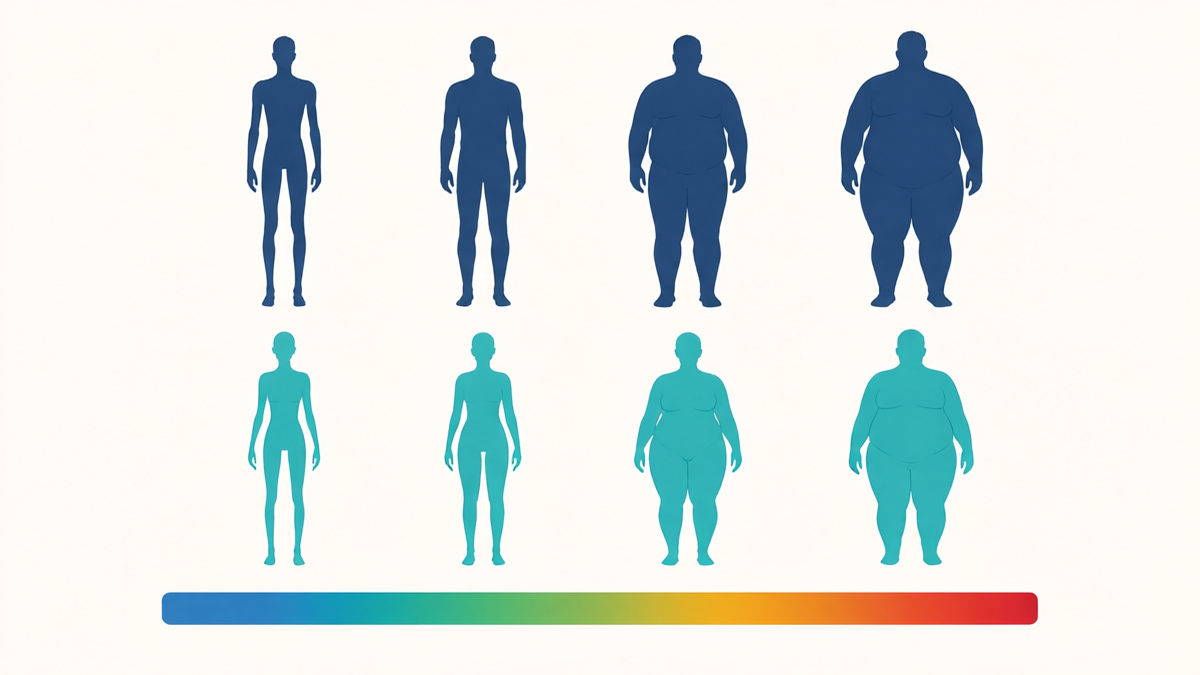
Women naturally carry more essential fat than men for hormonal and reproductive health, so the categories differ by sex. These ranges follow the body-fat norms published by the American Council on Exercise.
Men — body fat percentage categories
| Category | Body fat |
|---|---|
| Essential fat | 2–5% |
| Athletes | 6–13% |
| Fitness | 14–17% |
| Average / acceptable | 18–24% |
| Above average | 25% and over |
Women — body fat percentage categories
| Category | Body fat |
|---|---|
| Essential fat | 10–13% |
| Athletes | 14–20% |
| Fitness | 21–24% |
| Average / acceptable | 25–31% |
| Above average | 32% and over |
So is 18% body fat "chubby"? For a man, 18% sits right at the top of the fitness range and the start of average — lean and healthy, with visible but not sharply defined muscle. For a woman, 18% is in the athletic range, leaner than most. Context matters more than the label: these numbers also drift upward with age, and a reading that is healthy at 50 can look different from one at 25.
US Navy Body Fat Standards (BCA)
This is where searches for navy body fat standards and navy BCA usually land, so it is worth being precise: the number this calculator gives you is an estimate for personal tracking, not an official Body Composition Assessment (BCA) result. The Navy's actual pass/fail process is run by the command, measured by trained staff, and governed by current Navy instructions.
The Navy screens in steps. The first gate is a single abdominal/waist measurement — recent Navy guidance uses a waist-to-height ratio of 0.55 or lower as the pass, with an equivalent single-measure abdominal circumference screen near 39 inches for men and 35.5 inches for women. Only if a sailor exceeds that screen is body fat estimated with the circumference method. The maximum allowable body fat for serving members is in the region of 26% for men and 36% for women (some guidance applies tighter limits to the youngest age groups). Because these thresholds are periodically revised, treat the figures here as orientation and confirm the current standard in the official MyNavyHR Body Composition Assessment guide.
If you are preparing for a Navy PFA or BCA, use this tool to track the trend and know roughly where you stand — then rely on your command's official measurement for the number that counts.
Navy Body Fat Calculator for Women
Women use a different equation and one extra measurement — the hips — because female physiology stores more essential fat and distributes it differently. Select Female in the calculator and a hip field appears; leave the male formula selected and the result will be wrong, so the toggle matters.
Two things women should know when reading the result. First, a healthy woman's body fat is naturally 8–10 percentage points higher than a man's across every category — that is biology, not a problem to fix. Second, the waist-plus-hip-minus-neck term makes the female formula sensitive to how you measure the hips; find the true widest point and keep the tape level. During the menstrual cycle, fluid retention can nudge waist measurements by a centimetre or two, so measure at the same point in your cycle when tracking change. Body fat below the essential range (under about 10–13%) can disrupt menstruation and bone health and is worth raising with a clinician.
Navy Body Fat Calculator for Men
Men need just three measurements: neck, waist and height. The formula keys heavily on the gap between your waist and neck, so the waist reading is where accuracy is won or lost — measure at the navel, at the end of a normal exhale, without pulling your stomach in.
The method's main quirk for men is muscularity. A lean, heavily-trained man with a thick waist from developed abdominal muscle can read a touch high, while the number tracks fat loss accurately as the waist shrinks. If your goal is a visible six-pack, most men see abs start to appear around 10–12% body fat; the 14–17% fitness range is lean and athletic without being extreme. Chasing essential-fat levels (2–5%) is neither necessary nor healthy to maintain.
Navy Method vs Other Body Fat Tests
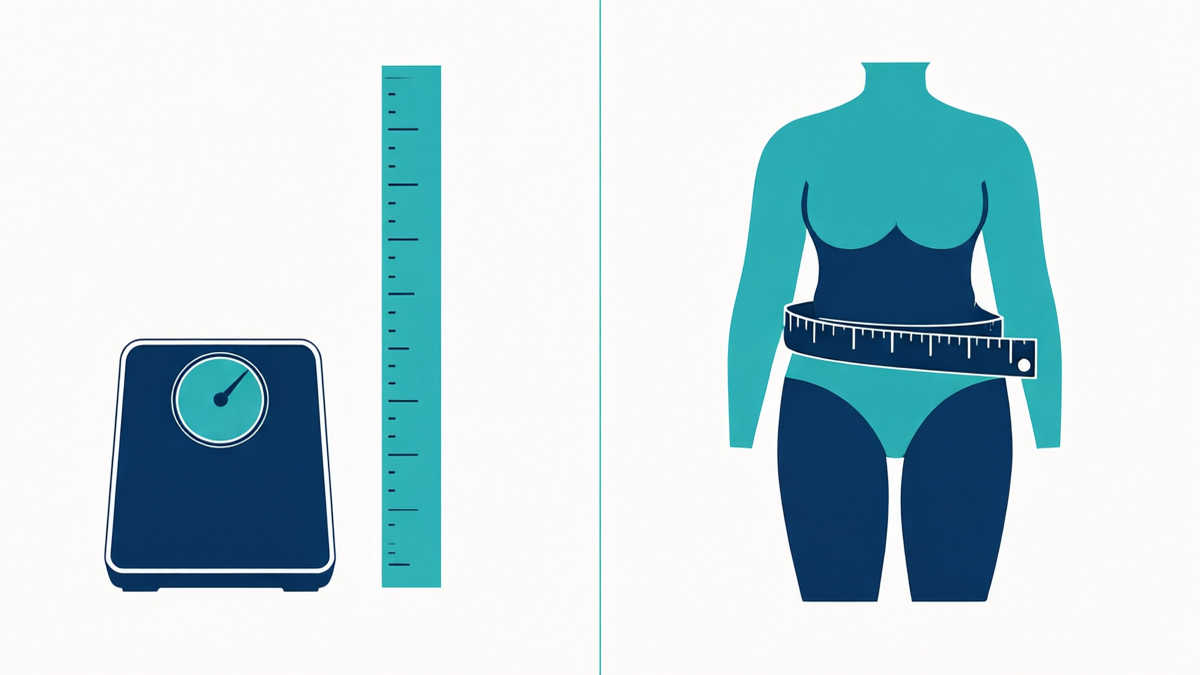
Against BMI, there is no contest for body composition: BMI divides weight by height and cannot tell a muscular athlete from someone carrying excess fat, so it routinely misclassifies fit, heavier-muscled people as "overweight." The Navy method measures where fat actually sits, which is the whole point. The two answer different questions — BMI screens weight-for-height at a population level; the Navy method estimates your personal fat percentage — and they pair well.
The military services use closely related circumference methods, which is why people search for an army body fat calculator alongside this one. The Army, Marine Corps and Air Force each use their own measurement points and allowable limits, but the underlying tape-measure approach is the same family as the Navy's. If you need a service-specific pass/fail number, use that branch's official standard; for general tracking, the Navy method here is representative.
For a fuller picture of your body and energy needs, read your body fat alongside your BMI calculator, your basal metabolic rate, and your daily calorie needs.
Is There a Navy Body Fat Calculator App?
You do not need to download anything — the calculator on this page works on any phone, tablet or computer browser, which is what most people actually want when they search for a navy body fat calculator app. It runs offline once the page has loaded, remembers nothing, and sends none of your measurements anywhere. Bookmark this page and it behaves like an app: open it, enter your tape readings, done. Several standalone apps exist in the app stores if you prefer a native one, but for occasional tracking a bookmarked web tool is simpler and private.
Health and Medical Disclaimer
This navy body fat calculator and the information on this page are provided for general informational and educational purposes only. They are not medical advice, diagnosis or treatment, and are not a substitute for consultation with a qualified healthcare professional. The US Navy circumference method produces an estimate — typically within a few percentage points of a laboratory measurement — and is not an official Body Composition Assessment result. Body fat percentage does not by itself describe your health; genetics, medical conditions, medications and fitness all matter. Do not use this tool to make decisions about restrictive dieting, and never aim for body fat at or below essential levels. Very low body fat can harm hormonal function, bone health and, in women, menstruation. If you are concerned about your weight, body composition, or your relationship with food or exercise, speak to your GP, a registered dietitian or another qualified clinician. This tool is not intended for assessing children or teenagers, pregnant women, or anyone with a medical condition affecting body composition.
Frequently Asked Questions About the Navy Body Fat Calculator
1. How do you calculate Navy body fat?
Measure your height, neck and waist (women also measure hips), then apply the US Navy circumference formula. For men it is 495 ÷ [1.0324 − 0.19077 × log10(waist − neck) + 0.15456 × log10(height)] − 450, with measurements in centimetres; women add the hips and use a sex-specific equation. The calculator at the top of this page does the full calculation in metric or imperial units automatically — you just enter the tape-measure readings. The method originates with the Naval Health Research Center.
2. Is the Navy body fat calculator accurate?
For most people it is accurate to within about 3–4% of a DEXA scan or hydrostatic weighing when measurements are taken carefully and consistently. That is reliable enough to track real progress, though not a substitute for a clinical body-composition test. It is least accurate at the extremes — very lean or very heavy bodies — and can misread people with a lot of abdominal muscle. Consistent technique and timing matter more than any single reading. Norms per the American Council on Exercise.
3. Is 18% body fat chubby?
No. For a man, 18% body fat sits at the top of the fitness range and the start of the average band — lean and healthy, with muscle definition that is visible but not sharp. For a woman, 18% is in the athletic range, leaner than most people. "Chubby" is not a medical category; body fat should be read against sex-specific ranges and your age, not a single universal number.
4. What measurements do I need for the Navy method?
Everyone needs height, neck circumference (just below the Adam's apple) and waist circumference (at the navel). Women also measure hip circumference at the widest point. You do not need your weight for the body fat percentage itself — though adding it lets the calculator show your fat mass and lean mass. These few circumferences were chosen because they correlate strongly with total body fat while being easy to measure at home.
5. Is the Navy body fat calculator different for men and women?
Yes. The formulas are sex-specific and women measure one extra site — the hips — because female fat distribution and essential-fat needs differ. A healthy woman's body fat runs 8–10 percentage points higher than a man's across every category. Make sure the correct sex is selected in the calculator, because using the male formula on female measurements (or vice versa) produces a meaningfully wrong result.
6. What are the US Navy body fat standards?
The Navy screens first with a waist-to-height ratio (0.55 or lower passes) or an equivalent single abdominal measurement near 39 inches for men and 35.5 inches for women. Sailors who exceed the screen have body fat estimated by the circumference method, with a maximum allowable level in the region of 26% for men and 36% for women. Exact limits are set by current Navy instruction and can change, so confirm them in the official MyNavyHR Body Composition Assessment guide. This calculator estimates body fat for personal use; it is not an official BCA.
7. Is there an Army body fat calculator too?
Yes — the Army, Marine Corps and Air Force each use their own tape-measure methods and allowable limits, all in the same circumference-measurement family as the Navy's. The measurement points and pass/fail thresholds differ by service, so for an official number use your branch's own standard. For general body-composition tracking, the Navy method on this page is representative of the approach.
8. How often should I calculate my body fat percentage?
Every 2–4 weeks is the sweet spot for tracking progress. Body fat changes slowly, so daily or even weekly readings mostly reflect water and measurement noise rather than real change and can be discouraging. Measure under the same conditions each time — morning, before eating, same tape positions — and watch the trend over a month or more rather than reacting to any single figure.
9. Can I use this calculator to track weight loss?
Yes, and it is more informative than the scale alone. As you lose fat and build or keep muscle, your body fat percentage drops even when your weight stalls — which is exactly the progress a scale hides. Add your weight in the calculator to see your fat mass and lean mass split out, so you can confirm you are losing fat rather than muscle.
10. Does body fat percentage change with age?
Yes. Body fat tends to rise gradually with age even at a stable weight, as muscle mass declines — often by a few percentage points per decade after 30, particularly for women. A body fat percentage that is healthy at 25 may look different at 55, and both can be perfectly normal. Use age-appropriate expectations and focus on your own trend rather than a fixed target.
Sources and References
- Naval Health Research Center — A Survey of Body Fat Content of U.S. Navy Male Personnel (Hodgdon and Beckett)
- Naval Health Research Center — Prediction of Percent Body Fat for U.S. Navy Women from Body Circumferences and Height
- MyNavyHR — Physical Readiness / Body Composition Assessment guidance
- American Council on Exercise — Percent body fat norms and calculator
- LibreTexts Medicine — The U.S. Navy body fat estimation formula
Content last reviewed: 17 October 2026. This page is reviewed against US Navy / DoD body-composition guidance and the widely used fitness-industry body-fat categories, which are an industry convention rather than guidance issued by a single normative body, and updated when those standards change.